|
|
 |
|
About IPTV |
|
|
IPTV streaming is the best way to distribute live TV, radio and video channels around your organisation
|
|
What Is IPTV? |
|
|
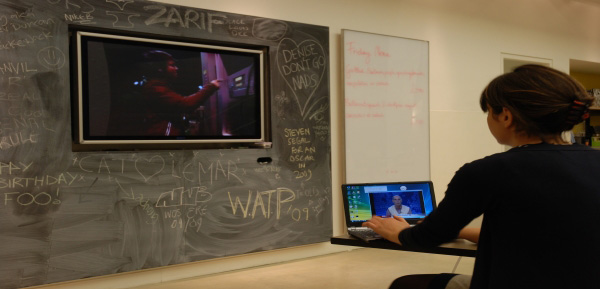
IPTV lets you stream televsion, radio and video channels within a building, around an organisation, or across several different sites.
By putting broadcast TV and your own audio-visual channels onto your IT computer network, IPTV from Netvue lets you simply and easily show TV and video anywhere.
|
|

|
|
You can add local video sources, such as DVD players or cameras, and have Video On Demand (VOD) programmes and your own TV channels streaming from your Video On Demand server.
IPTV combines TV distribution technology with IT data infrastructure, and is based on TV and IT industry standards. By using standard IT protocols to deliver video services, IPTV technology benefits from the continuous advances and improvements in IT technology.
|
|
IPTV Benefits |
 |
|
|
An IPTV system has several advantages over a conventional television distribution system, sometimes known as an RF system:
|
 |
IPTV uses the existing computer network
- no new cables, no hassle!
|
|
IPTV works with all display
devices - TV's, Projectors, LCD
displays, computer desktops
|
|
IPTV lets you put TV displays
anywhere - just connect to the nearest IT network
point to show TV and video
|
|
IPTV offers remote system management -
manage all your IPTV equipment by simply using a web browser
|
|
Performance and Operational benefits: |
|
Feature |
Old Technology TV Distribution System |
IPTV Televsion and Radio Distribution |
Cabling |
Needs dedicated video cabling |
Runs on the IT network - no special cabling |
Displays |
Can only use TV displays |
PC and Mac desktops, any displays or projectors |
High Definition |
Limited HD or 4K support |
HD and 4K both supported |
Channels & Users |
Limited number of channels and users |
Unlimited channels and unlimited users |
User control |
None |
Full control of user access to IPTV channels |
System Admin |
None |
Remote system admin via the network |
Multi-site |
Requires costly dedicated links |
Uses company network links |
Scalability |
Requires costly additional cabling |
Easily scalable because IPTV is there on the IT network |
System Links |
None |
Links with other IT services like VOD and Digital Signage |
|
|
IPTV Technology |
 |
|
|
IPTV combines TV compression technology and IT data technology to stream TV and video as a continuous flow of data packets on an IT network. IPTV successfully combines two established technology standards:
|
|
IP data addressing and transmission
|
|
MPEG digital television compression
|
|
The IPTV channel streams are distributed ONLY to the destinations that request a channel, by using multicast protocols. This ensures that bandwidth requirements on the IT network are minimised.
Click on the IPTV Multicast picture or click here for our pdf document on Netvue IPTV technology.
|
|
|
|
|
|